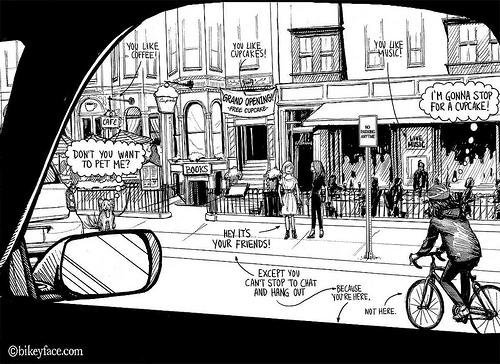


You're overlooking that small volume, grocery stores like that have items that cost a lot more than suburban grocery stores or warehouse clubs. Shoppers are extremely price sensitive, unless they're so wealthy that its not an issue, which is pretty much all of the upper class in SoCal who aren't price conscious about their $1.2 million dollar house in the Hollywood Hills. I think you would actually be happiest with that "no man's land" in-between suburbia and the formal inner city where vertical building is a priority and they still take up entire blocks for your high volume, low-cost shopping convienience. It's not quite an inner city neighorhood but it is still designed around the automobile with a few lower levels of garage space for parking space (no open lots like in suburbia).Pointedstick wrote: And of course there's always the option in such a sanely-designed city of living in a multi-story apartment building with an elevator and a grocery store on the ground floor. They even have these kinds of mixed-use buildings in a lot of American cities.
Incidientally, Whole Foods just opened up its first 365 store in Los Angeles this week. They're getting the message. Now if something like that was on the bottom level of a small high-rise, it would be wonderful. But that just doesn't happen. No, its gonna be in sprawling suburbia, "no man's land" multiple deck shopping mall that you have to drive to get to or in an overcongested inner city with tons of other shops. I really don't know how people buy a lot of groceries in an inner city. It seems like a logistical nightmare.





 But hey, how are you going to create a better future if you can't imagine it? Just because things are good, that doesn't mean they couldn't be better!