Page 2 of 4
Re: Taxes and Trump
Posted: Wed Jan 27, 2016 1:56 pm
by MediumTex
Libertarian666 wrote:
moda0306 wrote:
Libertarian666 wrote:
I have an even simpler plan.
Eliminate all Federal taxes and let the Fed print whatever money the Federal government wants to spend.
Since the US is a "currency issuer" and therefore doesn't have to worry about hyperinflation, this is the simplest and most effective tax reform plan possible!
Nobody says they don't have to worry about hyperinflation. In-fact, even with a system like that, the problem WOULD be inflation if you spent a bunch of money into the economy without taking some out. But anyway...
Re-fajiggering our entire monetary system wasn't really in the scope of my plan. It was simply how to reform the tax code to those three mentioned metrics.
Considering that limited scope, what are your thoughts? Remember, we have to maintain revenue neutrality, so you can't eliminate the tax.
My other plan is to cut the Federal government back to doing only what is explicitly authorized in the Constitution, which is approximately 1% of what they do today.
Then you could eliminate income taxes and FICA and still have plenty of money left over.
As I recall, the only tax authorized by the Constitution was in the form of tariffs on trade.
Re: Taxes and Trump
Posted: Wed Jan 27, 2016 2:01 pm
by moda0306
Libertarian666 wrote:
moda0306 wrote:
Libertarian666 wrote:
I have an even simpler plan.
Eliminate all Federal taxes and let the Fed print whatever money the Federal government wants to spend.
Since the US is a "currency issuer" and therefore doesn't have to worry about hyperinflation, this is the simplest and most effective tax reform plan possible!
Nobody says they don't have to worry about hyperinflation. In-fact, even with a system like that, the problem WOULD be inflation if you spent a bunch of money into the economy without taking some out. But anyway...
Re-fajiggering our entire monetary system wasn't really in the scope of my plan. It was simply how to reform the tax code to those three mentioned metrics.
Considering that limited scope, what are your thoughts? Remember, we have to maintain revenue neutrality, so you can't eliminate the tax.
My other plan is to cut the Federal government back to doing only what is explicitly authorized in the Constitution, which is approximately 1% of what they do today.
Then you could eliminate income taxes and FICA and still have plenty of money left over.
Remember you have to be revenue neutral right? You can't go in just cutting programs as that's an expense item. Not revenue.
If you had to reform the income tax code and stay revenue neutral, can you give us some idea of what framework you'd suggest? I know it's imperfect, but give it a try. I'm curious what you'd come up with.
Btw, please include any changes to FICA/Medicare taxes, as those are a massive revenue item.
Re: Taxes and Trump
Posted: Wed Jan 27, 2016 2:04 pm
by jafs
MediumTex wrote:
jafs wrote:
I understand very well how SS works.
Really? Then why are you talking about the sustainability of the program?
And, I'd help out the poorest folks in a lot of different ways.
Right, but most of what I've heard from you seems to involve telling businesses how much to pay their employees, regardless of the employees' worth to the organization. IMHO, that approach won't solve any of the problems you have identified.
I have identified three different alternative approaches (i.e., payroll tax cut, improved negotiation and enforcement process on trade deals, and expanded government employment for otherwise unemployable workers) that could get us to the place you say you want to go , and you have poo pooed all three of them.
I'm trying to work with you here, but it's starting to seem a little troll-ish the way you don't want to explore creative solutions to the problem you have identified. You just want to say that CEOs are overpaid, the minimum wage is too low, and you feel unwelcome and unsafe, even though you've got the smartest people here working with you to try to crack the nut you have brought to us.
But cutting revenue just increases sustainability issues if no other changes are made.
Well, many would say that if you increased employment at the bottom of the wage scale, almost every dollar in new wages would be spent, which would stimulate the economy. A stimulated economy expands, which has a tendency to increase tax revenue.
You're also using that "sustainability" word again. If nothing else, I would like to see you loose up your thinking about this issue. There are no "sustainability" issues when it comes to the U.S. government and its spending levels. A world reserve currency issuer MUST run large budget deficits and maintain a large national debt in order to provide a bond market with enough liquidity to handle the largest international transactions. That's a hard pill to swallow, but it's true. The U.S. government's constraints are mostly political and cultural--they aren't financial.
Overall, revenue has to be equal to or greater than spending to balance the budget and/or create a surplus. I know a lot of you don't care about that, and don't think it's any sort of real problem.
It has nothing to do with what I or anyone else here care about or think is a problem. What you are doing is the equivalent of saying that when it thunders it means God got drunk and fell down in Heaven, and what I am saying is
NO, there is a much better explanation for the thunder than that.
Sorry if that seems a little harsh, but in order to have a meaningful discussion about these issues, you've got to open your eyes to how our system actually works. It's worth the effort, trust me. Put you ego aside for a moment and look at things without preconceptions. It's shocking what you will find has been right under your nose all of this time. Most of the people here have had one or more of these "aha" moments. It's worth the effort.
Personally, I have some ideas about how to improve/change SS and Medicare, but they involve serious changes to the program that will never be considered.
Me too. How about Medicare for everyone and only pay SS to people with W-2 income under $1 million a year?
And, I'm not "supposed" to be anybody, I'm just who I am.
It sounds like who you are is who you are supposed to be. That's all I was saying. I was just depending on you to be you.

I never poo-poohed those other ideas. In fact, I said that I liked the idea of better trade deals and government jobs programs.
As far as the rest, I'm not going to get into that whole thing again - I understand that you have a very strong view of how the monetary system works and think I'm dead wrong that deficits/national debts matter.
It's true that a payroll tax cut for those at the bottom would stimulate the economy, and that would be a good thing. But it wouldn't stimulate it enough to make up the lost tax revenue - if you think about tax percentages, you'd have to have a tremendous multiplier and nobody really thinks that spending has that high of an effect of that sort.
Feel free to ignore my comments about fiscal sustainability if they upset you too much - I won't be offended

I'd re-structure them even more radically, as "insurance" programs, means/asset tested in some way. Come up with a minimum income that we find reasonable, and then subsidize anybody who can't generate that on their own in retirement, and give them free health care. Then some sort of sliding scale from that level up to another level, at which somebody becomes ineligible for the health care part.
So, for example, if we set the income level at $18K/yr. and somebody could generate half of that, the government would provide the other half and give them free health care (no premiums, deductibles, etc.). Somebody who makes between $18-$20K would get health care for some low premiums, $20-$25K a bit higher, etc. until we reach the cutoff. After that the private sector would provide the health care/insurance.
I'd also eliminate taxation on the full $18K, so that people actually have that much to live on.
Those numbers are just for illustration, and I'm not that attached to them.
Re: Taxes and Trump
Posted: Wed Jan 27, 2016 2:05 pm
by jafs
MediumTex wrote:
Libertarian666 wrote:
moda0306 wrote:
Nobody says they don't have to worry about hyperinflation. In-fact, even with a system like that, the problem WOULD be inflation if you spent a bunch of money into the economy without taking some out. But anyway...
Re-fajiggering our entire monetary system wasn't really in the scope of my plan. It was simply how to reform the tax code to those three mentioned metrics.
Considering that limited scope, what are your thoughts? Remember, we have to maintain revenue neutrality, so you can't eliminate the tax.
My other plan is to cut the Federal government back to doing only what is explicitly authorized in the Constitution, which is approximately 1% of what they do today.
Then you could eliminate income taxes and FICA and still have plenty of money left over.
As I recall, the only tax authorized by the Constitution was in the form of tariffs on trade.
Not true from my reading of Article 1, Section 8 - it authorizes a wide variety of taxes.
Re: Taxes and Trump
Posted: Wed Jan 27, 2016 2:11 pm
by MWKXJ
moda0306 wrote:
Sorry if that all seems complicated. When you try to talk about the flaws of our current tax-code and the benefits of one going forward, you essentially need to say WHY the current complications need to go rather than talking about "a few brackets" and getting rid of "some deductions."
Nice, detailed analysis of Trump's plan, Moda. Enjoyed reading it.
Regarding your proposal for a replacement tax code: Personally, I'd opt for a taxing scheme which adhears to a "creative destruction" philosophy: a flat, transparent, consumption tax. In other words, when one pays for something one sees a line marked "Federal 25%" right below any state and local sales taxes. Would I enjoy paying it? Hell no! ...but neither would millions of other Americans, and it's precisely that anger which might---finally---result in fiscal prudence at the national level.
Moreover, the "Federal 25%" rate would be set to whatever percentage is necessary to *honestly* begin paying down the nation's debt in the span of say, a single congressional or presidential election cycle. Consequently, the rate could be far higher than 25%. If and when the debt is ever paid down the rate would be---possibly---lowered in keeping with the fiscal year's adopted budget. Of course, if the Federal government continues to overspend, the rate will never be reduced and the public ire will only increase.
I can't think of any other tax plan which is both more brutally honest to the taxpayer, and, more effective at curbing government excess.
Re: Taxes and Trump
Posted: Wed Jan 27, 2016 2:13 pm
by Pointedstick
jafs wrote:
As far as the rest, I'm not going to get into that whole thing again - I understand that you have a very strong view of how the monetary system works and think I'm dead wrong that deficits/national debts matter.
If you're not willing to consider alternative points of view, what's the point in discussing these kinds of matters in the first place? Serious question. Why bother?
Re: Taxes and Trump
Posted: Wed Jan 27, 2016 2:16 pm
by jafs
Consumption taxes are generally understood to be regressive.
And, a very likely response to heavy consumption taxes would be less consumption, which would hurt the economy and also not provide the desired government revenue.
Re: Taxes and Trump
Posted: Wed Jan 27, 2016 2:18 pm
by jafs
Pointedstick wrote:
jafs wrote:
As far as the rest, I'm not going to get into that whole thing again - I understand that you have a very strong view of how the monetary system works and think I'm dead wrong that deficits/national debts matter.
If you're not willing to consider alternative points of view, what's the point in discussing these kinds of matters in the first place? Serious question. Why bother?
I'm not sure I understand your question. I was discussing possible changes to the tax structure based on moda's post, and MT jumped in with a diatribe about how I'm wrong about the whole monetary system and the way it works.
Should every conversation that has money in the subject matter in any way turn into that one?
There are a lot of other interesting conversations to be had about money/government in my understanding, without turning them all into that one.
If you all are right, then I'm wrong - why isn't that enough? It seems a bit like religion and the desire for believers to "convert" non-believers.
Re: Taxes and Trump
Posted: Wed Jan 27, 2016 2:20 pm
by MediumTex
jafs wrote:
As far as the rest, I'm not going to get into that whole thing again -
I understand that you have a very strong view of how the monetary system works and think I'm dead wrong that deficits/national debts matter.
[...]
Feel free to ignore my comments about fiscal sustainability if they upset you too much - I won't be offended
Just to be clear, saying that I have a "view" on how the monetary system works would be like saying you have a "view" on what gravity is all about. It's far more than a view--it's a set of theories that have been validated over the last 30 years when every other explanation has been shown not to be comprehensive.
I am not bringing this up for the purpose of telling you that you are wrong and I am right. Rather, I am bringing it up to let you know that there is an interesting, and even exciting, world of ideas out there that can actually provide a real understanding of how our fiscal and monetary system actually works, including why the rates on our bonds have
fallen the more our debt and deficits have
grown.
I'm sure you don't realize it, but your mind is stuck in an obsolete theoretical framework that has a political, not economic, orientation. There is a more reality-based method of understanding how things work that most people find far more intellectually satisfying. You should check it out. You've got nothing to lose.
Re: Taxes and Trump
Posted: Wed Jan 27, 2016 2:31 pm
by MediumTex
jafs wrote:
Pointedstick wrote:
jafs wrote:
As far as the rest, I'm not going to get into that whole thing again - I understand that you have a very strong view of how the monetary system works and think I'm dead wrong that deficits/national debts matter.
If you're not willing to consider alternative points of view, what's the point in discussing these kinds of matters in the first place? Serious question. Why bother?
I'm not sure I understand your question. I was discussing possible changes to the tax structure based on moda's post, and MT jumped in with a diatribe about how I'm wrong about the whole monetary system and the way it works.
Should every conversation that has money in the subject matter in any way turn into that one?
There are a lot of other interesting conversations to be had about money/government in my understanding, without turning them all into that one.
If you all are right, then I'm wrong - why isn't that enough? It seems a bit like religion and the desire for believers to "convert" non-believers.
If you're going to bring up debt and deficits and why they matter in a tax discussion, you've got to be ready for someone to challenge you about
why debt and deficits matter.
As far as why we would like you to consider learning something new that might clarify your thinking, take it as a compliment. It's a sign of intellectual respect. Please understand, though, that unlike a religion, I don't think that anyone here would ask that you take anything on faith. What I think we would like you to do is invest the time and energy in looking at the theories we are referring to and make up your own mind.
People who rely on magical thinking rarely think of it that way. We all come out of the darkness in our own way and in our own time. Often, however, the catalyst for throwing off outmoded ways of thinking is meeting someone new who introduces you to a set of ideas that, in retrospect, you realize
you were ready to hear.
Re: Taxes and Trump
Posted: Wed Jan 27, 2016 2:32 pm
by Pointedstick
jafs wrote:
I'm not sure I understand your question. I was discussing possible changes to the tax structure based on moda's post, and MT jumped in with a diatribe about how I'm wrong about the whole monetary system and the way it works.
Should every conversation that has money in the subject matter in any way turn into that one?
There are a lot of other interesting conversations to be had about money/government in my understanding, without turning them all into that one.
If you all are right, then I'm wrong - why isn't that enough?
Because it makes it impossible for you and the rest of us to discuss government budgets and taxes because we have different understandings of how they work. It would be like two physicists trying to theorize about what would happen to a ball thrown off a cliff when one of them only conditionally accepts the concept of gravity. It just doesn't work. If neither party changes their understanding, then the result is either endless frustrating and fruitless conversations that take up a lot of time and energy but go nowhere, or a sort of detente where one party or the other agrees not to engage in the discussion. We are trying to help you here by teaching you about the way the monetary system really works. Once you have learned this, our conversations will be more fun and probably expose substantial areas of overlap between our opinions that present opportunities for compromise.
Re: Taxes and Trump
Posted: Wed Jan 27, 2016 2:42 pm
by moda0306
MWKXJ wrote:
moda0306 wrote:
Sorry if that all seems complicated. When you try to talk about the flaws of our current tax-code and the benefits of one going forward, you essentially need to say WHY the current complications need to go rather than talking about "a few brackets" and getting rid of "some deductions."
Nice, detailed analysis of Trump's plan, Moda. Enjoyed reading it.
Regarding your proposal for a replacement tax code: Personally, I'd opt for a taxing scheme which adhears to a "creative destruction" philosophy: a flat, transparent, consumption tax. In other words, when one pays for something one sees a line marked "Federal 25%" right below any state and local sales taxes. Would I enjoy paying it? Hell no! ...but neither would millions of other Americans, and it's precisely that anger which might---finally---result in fiscal prudence at the national level.
Moreover, the "Federal 25%" rate would be set to whatever percentage is necessary to *honestly* begin paying down the nation's debt in the span of say, a single congressional or presidential election cycle. Consequently, the rate could be far higher than 25%. If and when the debt is ever paid down the rate would be---possibly---lowered in keeping with the fiscal year's adopted budget. Of course, if the Federal government continues to overspend, the rate will never be reduced and the public ire will only increase.
I can't think of any other tax plan which is both more brutally honest to the taxpayer, and, more effective at curbing government excess.
I didn't want to get into big deficit reduction plans. ACTUALLY simplifying the code AND being revenue neutral would be a huge, huge jump forward for not just our tax system, but all the plans Republicans put forth (even Rand's plan, though he's honest about it not being revenue neutral at least).
Further, with my system, you can always increase tax brackets if you want to collect more revenue. One could also post spending cuts. Those are all directions we COULD go if folks wanna go, but I wanted to show folks who REALLY wanted simplicity, revenue neutrality (at least to start), and not hurting the middle class a way to do it.
But let's talk about a "consumption" tax.
First off, I've worked in sales tax (a consumption tax), and it's sort of a nightmare. What is a sale? If I sell you my time, what about my time and a tax return? What if I sell you consumer good? What about a capital good (machine, car)? What about real estate? What is consumption? Many of the things we "buy" don't get "consumed" right away. A lot of things we buy are labor, not a good. These are treated in a myriad of ways by our sales tax system. It's really complex. Much more-so than an income-tax system could be. And it seems a lot more arbitrary to me where to draw the line, to boot?
Also, if we're going to stay revenue neutral including FICA/Medicare taxes, how large would that tax have to be? I know I know.... REPEAL ALL PROGRAMS! But really? Can't we solve one big problem at a time? If government excess is TRULY the main problem, and we should repeal 90% of what the government does, then how we tax barely matters, so why bother coming up with a fancy new tax code? It's not worth worrying about it.
But if we ARE going to have a federal government that does social insurance, military, etc, then we can STILL improve our tax system to realize that, and have to act in that reality. We don't have to solve all of our problems at once. And I don't think a consumption tax would really solve any, and would cause a whole new slew of problems.
Re: Taxes and Trump
Posted: Wed Jan 27, 2016 2:46 pm
by jafs
If it really doesn't matter at all, why not just stop collecting taxes at all, keep spending huge amounts of money, and just borrow it all?
I looked up monetary realism, and read some things about it, and I've followed the discussions on here about it for a while back now. Some of it makes complete sense and seems obvious, like the fact that banks don't lend their reserves and so having more reserves doesn't create inflation.
Other parts of it are less convincing - for example, they comment that the government controls interest rates for their bonds. This is only true if they can find borrowers who are willing to borrow at those rates.
Still other parts are oriented towards debunking ideas that I've never held nor ever would hold, such as their comment that "not all government spending is bad". Or that we have to pay all of the national debt off completely.
They also use Japan as an example, but Japan is usually not thought of as having a desirable economy.
I like the idea of understanding how things actually work - it's a good place to start from. But I also find that most things aren't completely captured by one ideological system - it's why I hold a mix of different ideas from liberal, conservative and libertarian philosophy.
Re: Taxes and Trump
Posted: Wed Jan 27, 2016 2:52 pm
by Pointedstick
jafs wrote:
If it really doesn't matter at all, why not just stop collecting taxes at all, keep spending huge amounts of money, and just borrow it all?
If the domestic and international demand for U.S. debt was sufficient to cover the spending, then this would absolutely be possible.
The limitation on U.S. federal government spending is not the revenue it collects but rather the availability of demand for treasury bonds.
If the demand is so large that it can meet 100% of the federal government's desired spending, then bob's your uncle.
Crazy, no?
I know, I know, this is dangerous because the demand for U.S. debt might dry up. What would cause this, though? International currency flows want to find a safe and stable place to live in the short to medium term. As long as the USA remains the safest and most stable place for this money, the shell game can continue. Nothing lasts forever of course, but once we understand that demand for U.S. debt is the real constraint with our crazy system, we can start to ask rational questions like how we keep up that demand and increase our attractiveness for those wishing to park their capital. These questions are much more sane than questions about the absolute size of the debt or deficit. The size doesn't really matter as long as there's a buyer for it; it's the supply of deficits relative to the demand for debts that's the critical metric.
This system rightly worries a lot of people who fret about its sustainability or wonder why in the world people would loan such vast amounts of money to the federal government. There are legitimate fears, but you have to start out acknowledging that it does seem to work and has for quite a while--longer than I and others here have been alive.
Re: Taxes and Trump
Posted: Wed Jan 27, 2016 3:00 pm
by jafs
And yet, with the fiscal cliff nonsense, credit rating agencies downgraded our debt ratings, which makes them less attractive to borrowers and/or means we need to pay higher interest rates.
Having a plan to deal with large projected deficits would be something that rating agencies like, and thus make bonds more attractive.
Maybe it's a question of relative vs. absolute, or something like that. There are many places in the world that are less stable, politically and economically, than the US. But that doesn't mean we're as stable or functioning as well as I'd like.
Well, things work until they don't, sometimes. And, I've never said we shouldn't have any debt, just that I'd like to see a more reasonable level of it, and not have it increasing every year by half a trillion to a trillion dollars.
We've also wielded a lot of power around the world for a while now, but that may be changing too - all empires eventually fall.
Re: Taxes and Trump
Posted: Wed Jan 27, 2016 3:23 pm
by Pointedstick
jafs wrote:
And yet, with the fiscal cliff nonsense, credit rating agencies downgraded our debt ratings,
So what?
jafs wrote:
which makes them less attractive to borrowers
Did they?
jafs wrote:
and/or means we need to pay higher interest rates.
Have we?
The constraint is demand for U.S. debt. Nothing more, nothing less. If the rest of the world is demanding half a trillion dollars a year of U.S. debt, then what's the problem? They know they're going to get paid back with money from lending to someone else. Everyone knows.
Open your mind! The truth is so crazy, it's kind of fun.

Re: Taxes and Trump
Posted: Wed Jan 27, 2016 3:37 pm
by WiseOne
Moda, thank you for your insightful analysis!
You're completely right about the payroll tax. It's not only regressive, it's a great way to hide taxation from from the people who pay it. Get it out in the open and include it with regular income tax - and watch those tax brackets suddenly look a lot like they do in, say, the UK or Canada.
Has anyone done an analysis to figure out what the new tax brackets would have to be, if you eliminated the payroll tax and did an across the board increase in the existing brackets to make up for it? It would be less than current rate + 15%, because the lack of a cap would increase the revenue quite a bit.
Tax simplification, reduced corporate taxation, increased fairness, revenue neutral, and a meaningful tax cut/effective pay increase for people in the lowest income bracket, all in one shot. Because of the simplification, it could have overall monetary benefits despite being officially revenue neutral. Sounds like a great idea to me.
Re: Taxes and Trump
Posted: Wed Jan 27, 2016 4:00 pm
by MediumTex
jafs wrote:
If it really doesn't matter at all, why not just stop collecting taxes at all, keep spending huge amounts of money, and just borrow it all?
You balance your spending needs through a mixture of tax revenue and what you get from the bond market. The bond market likes to see you making at least a token effort to finance a portion of spending through tax revenue.
I looked up monetary realism, and read some things about it, and I've followed the discussions on here about it for a while back now. Some of it makes complete sense and seems obvious, like the fact that banks don't lend their reserves and so having more reserves doesn't create inflation.
It's an integrated system and you really need to get a complete mental picture of it to understand what holds it all together. It's pretty abstract, and on the surface it can look kind of silly (sort of like Galileo's telescope might have looked to the clerics of his time).
Other parts of it are less convincing - for example, they comment that the government controls interest rates for their bonds. This is only true if they can find borrowers who are willing to borrow at those rates.
Interest rates are set by MANY factors, and a big one is a nation's ability to project military power to protect its economic interests. Think Great Britain in the 19th century for an example analogous to the U.S. today.
Still other parts are oriented towards debunking ideas that I've never held nor ever would hold, such as their comment that "not all government spending is bad". Or that we have to pay all of the national debt off completely.
You never pay off the national debt. It you did that, you would no longer have a bond market, which would mean that you wouldn't be able to serve as a reserve currency.
They also use Japan as an example, but Japan is usually not thought of as having a desirable economy.
I believe that Japan has the #3 or #4 largest economy in the world. An economy that productive is the envy of most of the world.
I like the idea of understanding how things actually work - it's a good place to start from. But I also find that most things aren't completely captured by one ideological system - it's why I hold a mix of different ideas from liberal, conservative and libertarian philosophy.
Right. It's good to have a toolbox with at least a couple of theories that you have completely internalized that you can flip up and down as needed like reading glasses of different strengths. When it comes to understanding the economy and our monetary system, most people only have one mostly outdated mental model, and that's one of the reasons that it's so poorly understood by most people, including a lot of policymakers.
Re: Taxes and Trump
Posted: Wed Jan 27, 2016 4:03 pm
by MediumTex
jafs wrote:
And yet, with the fiscal cliff nonsense, credit rating agencies downgraded our debt ratings, which makes them less attractive to borrowers and/or means we need to pay higher interest rates.
False.
When U.S. treasurys were downgraded a few years back, interest rates on U.S. debt
fell. When idiots like Cruz were making noise about defaulting on our debt, interest rate
fell.
Search "I did it for doodle" in this forum for a realtime discussion of how all this looked as it was happening from our perspective here. Once you have the right lens, seeing through all of the noise is pretty easy.
Re: Taxes and Trump
Posted: Wed Jan 27, 2016 4:06 pm
by MediumTex
jafs wrote:
We've also wielded a lot of power around the world for a while now, but that may be changing too - all empires eventually fall.
In modern times, unless they are led by a lunatic, empires tend to be decommissioned, rather than suffering outright failure.
The U.S. is clearly at the top of the food chain right now. In order for that to change, another country would have to take its place. Who could fill that role right now? That's right. No one. In fact, I don't think anyone would even want to, considering how much military spending it would take for someone else to replace the U.S. on the world stage.
Re: Taxes and Trump
Posted: Wed Jan 27, 2016 4:18 pm
by MediumTex
MediumTex wrote:
jafs wrote:
And yet, with the fiscal cliff nonsense, credit rating agencies downgraded our debt ratings, which makes them less attractive to borrowers and/or means we need to pay higher interest rates.
False.
When U.S. treasurys were downgraded a few years back, interest rates on U.S. debt
fell. When idiots like Cruz were making noise about defaulting on our debt, interest rate
fell.
Search "I did it for doodle" in this forum for a realtime discussion of how all this looked as it was happening from our perspective here. Once you have the right lens, seeing through all of the noise is pretty easy.
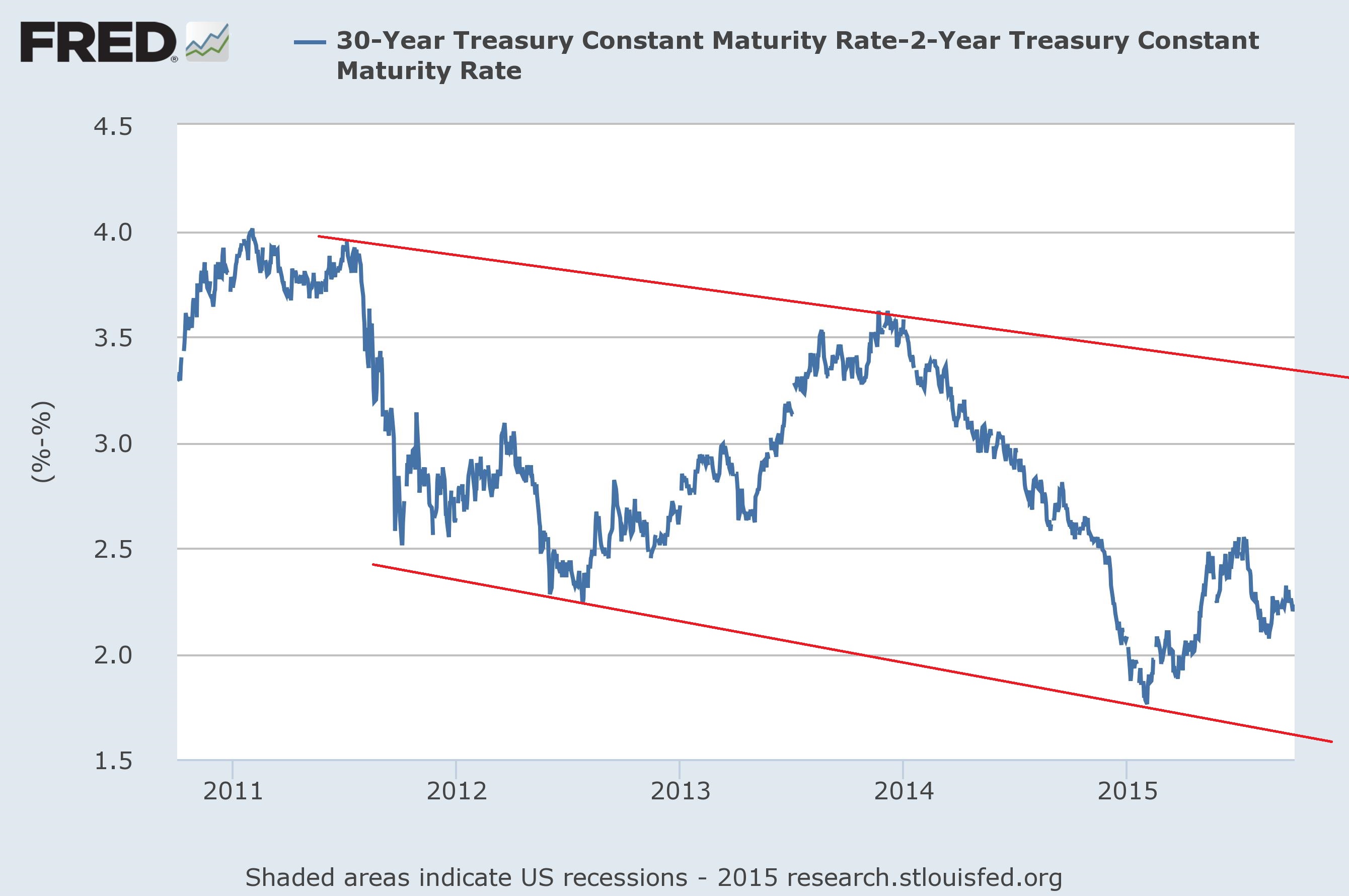
Maybe a picture will help.
U.S. treasurys were downgraded in August 2011. What happened to interest rates after that?
[img width=480]
http://c3352932.r32.cf0.rackcdn.com/con ... 77caeb.jpg[/img]
The rating agencies are like rodeo clowns. Just a distraction to make the show more entertaining. The bull is
never afraid of the clowns.
Re: Taxes and Trump
Posted: Wed Jan 27, 2016 4:19 pm
by jafs
Desert wrote:
I think the MR truth is just a tiny bit overplayed though. While I agree with the basic concepts, I think we also need to be clear that there are limits ... we just don't know where those limits are. Granted, the nation's finances are completely different than a household budget, but that doesn't mean that "deficits don't matter" (Cheney). It just means something like "Deficits haven't mattered much yet. They probably will at some level of debt and interest rates, but we don't know what those levels are, so we're really kinda just rolling the dice and hoping things continue on without blowing up."
Thanks - that's sort of what I think as well.
Re: Taxes and Trump
Posted: Wed Jan 27, 2016 4:22 pm
by MediumTex
jafs wrote:
Desert wrote:
I think the MR truth is just a tiny bit overplayed though. While I agree with the basic concepts, I think we also need to be clear that there are limits ... we just don't know where those limits are. Granted, the nation's finances are completely different than a household budget, but that doesn't mean that "deficits don't matter" (Cheney). It just means something like "Deficits haven't mattered much yet. They probably will at some level of debt and interest rates, but we don't know what those levels are, so we're really kinda just rolling the dice and hoping things continue on without blowing up."
Thanks - that's sort of what I think as well.
Remember, too, though, that the only time there was real concern about things "blowing up" was in the late 1970s
before we even started this crazy "deficits don't matter" experiment in the early 1980s. In other words, people were
more afraid of runaway inflation making it impossible to finance our debt back when we had a tiny fraction of the debt we have today. Stated differently, the conventional wisdom has been about as wrong as wrong can be about interest rates and debt levels
for almost 40 years!
[img width=200]
http://1.media.dorkly.cvcdn.com/50/27/0 ... 37ab1b.gif[/img]
[img width=300]
http://1.media.dorkly.cvcdn.com/50/27/0 ... 37ab1b.gif[/img]
[img width=400]
http://1.media.dorkly.cvcdn.com/50/27/0 ... 37ab1b.gif[/img]
[img width=500]
http://memeshappen.com/media/created/-H ... e-1827.jpg[/img]
Re: Taxes and Trump
Posted: Wed Jan 27, 2016 5:23 pm
by jafs
I had to go and look up what happened in 2011-on. Possibly in response to the credit downgrade, which was linked to a lack of reasonable plan for decreasing deficits, the government passed the budget control act of 2011, which set in place a plan for deficit reduction. Then, from 2011 onwards, the deficit steadily decreased.
So it seems more reasonable that what happened was that the government dealt with the underlying issue that prompted the credit downgrade, and deficits decreased, creating more confidence in Treasuries, which is why demand was still good and rates fell.
Re: Taxes and Trump
Posted: Wed Jan 27, 2016 5:32 pm
by MediumTex
jafs wrote:
I had to go and look up what happened in 2011-on. Possibly in response to the credit downgrade, which was linked to a lack of reasonable plan for decreasing deficits, the government passed the budget control act of 2011, which set in place a plan for deficit reduction. Then, from 2011 onwards, the deficit steadily decreased.
So it seems more reasonable that what happened was that the government dealt with the underlying issue that prompted the credit downgrade, and deficits decreased, creating more confidence in Treasuries, which is why demand was still good and rates fell.
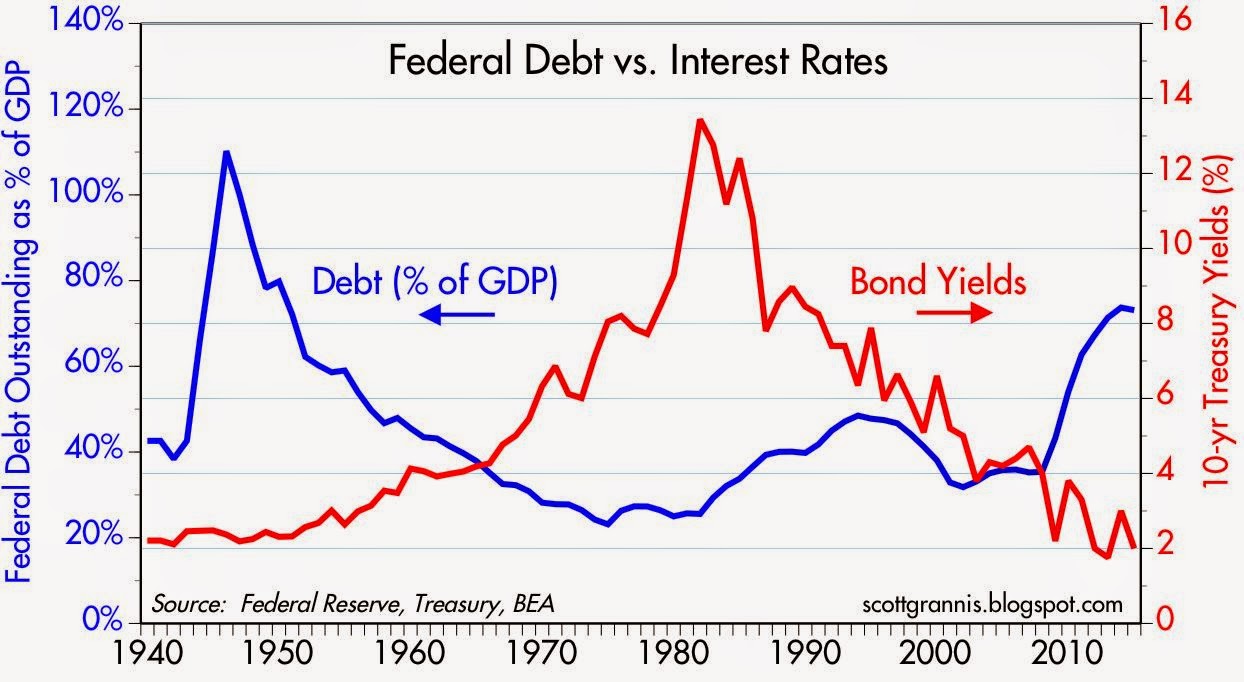
No relationship between national debt and interest rates, other than seemingly the higher the debt goes, the lower interest rates go. The national debt is, of course, just the accumulation of prior budget deficits.
You are positing a relationship that simply doesn't exist.
[img width=500]
http://3.bp.blogspot.com/-OsYgZZ7G_Os/V ... BRates.jpg[/img]